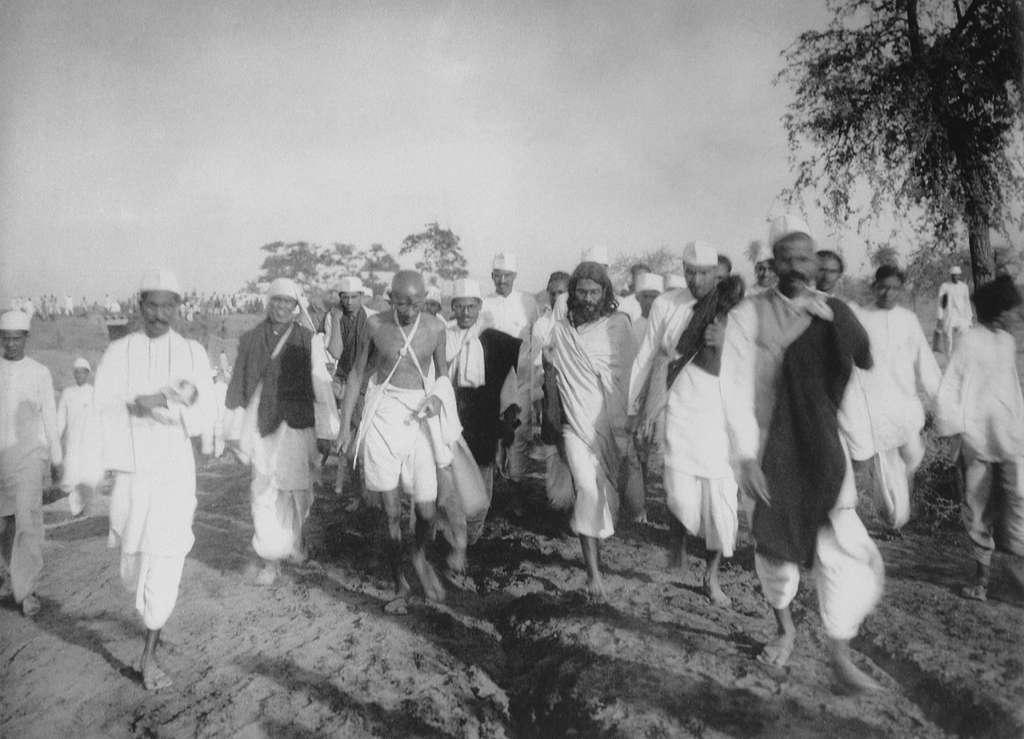
Satyagraha: Beyond Protest, Toward Process
01-Jan-1970
By Nidhi J. Makwana
In a world where protests dominate headlines, Gandhi's concept of satyagraha offers a different imagination of resistance. Gandhi and his ideology created a space and an ideal for a harmonious civilisation, accommodating differences without resorting to violent or aggressive conflict. His unique form of passive resistance, known as Satyagraha, promoted the idea of the world as one harmonious and inclusive family, even in disagreement.
Satyagraha emerged as the Gujarati equivalent of Gandhi's unique form of passive resistance. In 1908, Gandhi issued a notification in the Indian Opinion newspaper requesting readers to propose a new Gujarati term that embodied the concept of passive resistance. He selected the suggestion of Maganlal Gandhi, who proposed the term Sadagraha, meaning firmness in a good cause, derived from "sad" meaning good and "agraha" meaning emphasis, as a Gujarati equivalent for passive resistance. Gandhi later adapted this to Satyagraha, combining satya and agraha, highlighting satya or Truth as the fundamental principle, as he believed truth was universal and resonated with his spiritual and ethical ideals. For Gandhi, the neologisms of sad and satya differ. Sad often represents goodness in thought, action, and practice, which can be subjective or objective, while satya is Truth, which is universal. The definition of goodness varies with time and place, but Truth remains constant.
The standard interpretation of Satyagraha is passive resistance, primarily associated with political ideas, particularly in the context of conflict between colonisers and the colonised. However, Satyagraha is about self determination through nonviolent methods. It aims to change peoples hearts and minds rather than relying on forceful revolution. It is also notable that Satyagraha originates from the theological principles of Hinduism, Buddhism, and Jainism, which portray life's purpose as the pursuit of truth through nonviolence or ahimsa. Thus, Satyagraha encompasses politics, spirituality, and philosophy. In his later years, Gandhi recognised the difference and stated that Satyagraha differs from passive resistance as the North Pole differs from the South. If Satyagraha is not passive resistance, then what is the linguistic and rhetorical term for it.
Satyagraha is often used interchangeably with protest, yet it differs in both nature and conduct. Satyagraha is an ongoing process that may not conclude with the achievement of a specific goal, whereas a protest is usually organised for a particular aim. Additionally, Satyagraha must remain non-violent, whereas a protest is not necessarily non-violent at all times. Satyagraha is deeply rooted in ethics, where the end does not justify the means, whereas protest is often outcome oriented. This distinction becomes particularly urgent in today's world of digital activism, where hashtags can mobilise millions but also fade quickly. From global climate strikes to South Asian youth led movements, the spirit of satyagraha offers a reminder that resistance is not only about visibility or disruption but about cultivating ethical persistence. It asks whether movements transform participants inwardly as much as they challenge systems outwardly.
Gandhi was a man of preaching, practising, and understanding who lived by his teachings. Through practice and repetition, he gave rise to the concept of Satyagraha. The idea, as applied in his translation practice, became an essential part of his politics and philosophy. Gandhi's definition of what constitutes Satyagraha and what does not created various neologisms that are neither civil disobedience nor passive resistance, but rather an amalgamation of both. It is not easy to define the meaning of Satyagraha solely in terms of politics, spirituality, or philosophy, as it encompasses more than any single category.
Satyagraha also embodies philosophical principles of ethical conduct and an ideal state of being. It constitutes a spiritual struggle with oneself to rise above materialism and adopt inclusive religious pluralism, embracing the concept of sarvadharma sambhav. Satyagraha ultimately gained cultural significance by fostering identity and expression. As Bhikhu Parekh demonstrated, it became part of the Indian vernacular vocabulary. Satyagraha stands independently yet encompasses many philosophies, such as nonviolence and civil disobedience, influencing numerous political thinkers including Tolstoy, Ruskin, and Socrates. What initially appeared to be linguistic equivalence with passive resistance eventually evolved into a distinctive political philosophy, theory, and practice of the twentieth and twenty first centuries.
Gandhis Satyagraha provides a foundation for future generations to pursue greater goals rather than engage in goal oriented violent protest, which often leaves damaging consequences. For Gandhi, satyagraha was not only a political strategy but a way of waking up each morning committed to truth and nonviolence, even in ordinary acts. If protest seeks change, satyagraha seeks transformation.
References:
Gandhi, M. K. (1968). Satyagraha. In Gandhiji no Aksharadeha: Mahatma Gandhi na
lakhano, bhashano, patro vagereno sangraha (January 1908—August 1908) (Vol. 8,
pp. 467–473). Navajivan Prakshan Mandir.
https://www.gandhiheritageportal.org/cwmg_volume_thumbview/MTA=#page/56/mo
de/2up
Gandhi, M. K. (1996). An autobiography or the story of my experiments with truth (M. H.
Desai, Trans.). Navajivan Publication House.
Parekh, B. (1989). Gandhi’s Political Philosophy. Palgrave Macmillan UK.
https://doi.org/10.1007/978-1-349-09248-2
Skaria, A. (2016). Unconditional Equality: Gandhi’s Religion of Resistance. University of
Minnesota Press.
Suhrud, T. (with Gandhi, M. K.). (2019). The Power of Nonviolent Resistance: Selected
Writings. Penguin Publishing Group.

Useful Links
Quick Link
Contact
Sanket Development Group, Neelbad, Bhopal, MP 462044
Email: thenehrucentre.india@gmail.com
Phone: +91-9131242317
© 2025 The Nehru Centre. All Rights Reserved.